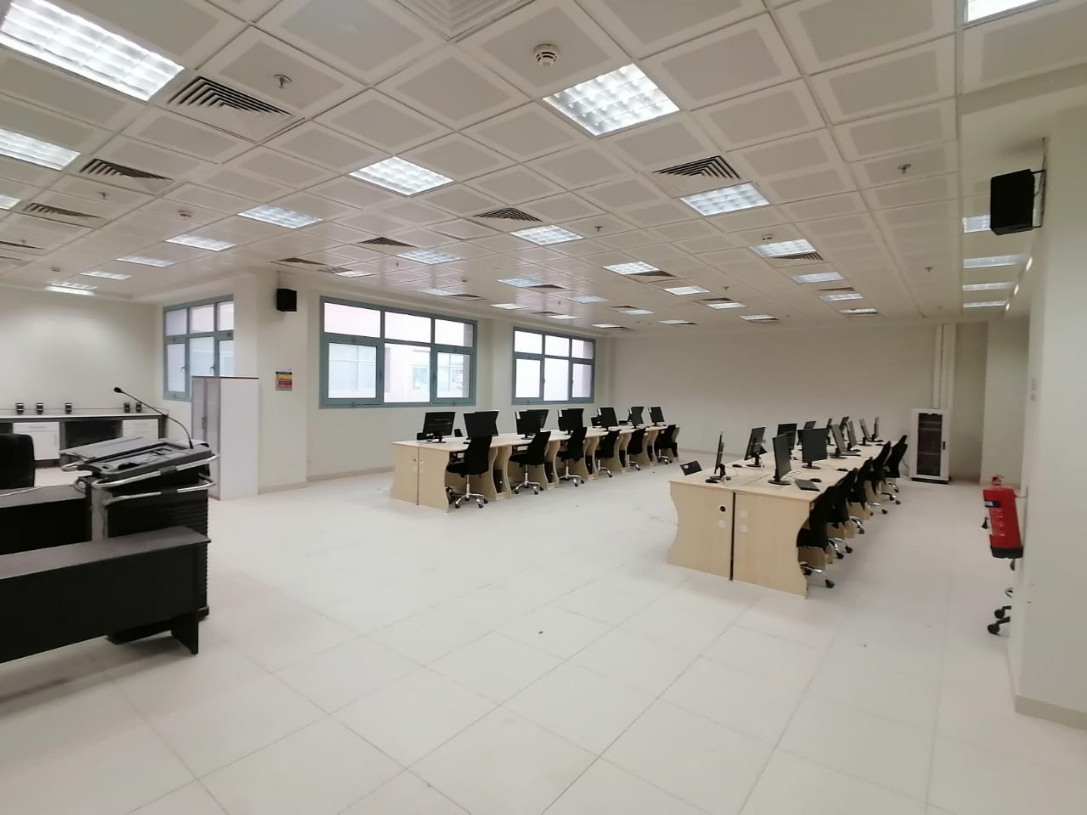


The Civil Engineering Department includes advanced laboratory facilities equipped with the latest specialized instruments that support the department’s educational activities. The laboratories also contain a number of integrated personal computer systems for running educational software. Each student is given the opportunity for hands-on practice and experimental experience, with only three to five students assigned to each experimental station. All civil engineering laboratories supporting the Bachelor of Civil Engineering program are located on the ground floor of the College of Engineering.
In the Environmental Engineering Laboratory, students learn to conduct experiments related to water and wastewater analysis methods, including:
- Determination of solids using the gravimetric method
- Spectrophotometric analysis and Beer’s Law
- Colorimetric analysis of phosphates
- Measurement of turbidity and acid–base titration
- Determination of biochemical oxygen demand (BOD) and chemical oxygen demand (COD)
- Bacterial count in water and coliform testing
- Determination of calcium content and water hardness measurement
- Detection of heavy metals and tracing pollutants

Through the Concrete Technology and Construction Materials Laboratory, students learn to conduct the following experiments:
- Sieve analysis of fine and coarse aggregates
- Determination of density, absorption, and abrasion of aggregates
- Determination of normal consistency of cement
- Setting time tests of cement
- Compressive and tensile strength tests of cement
- Design and testing of concrete mixes to achieve required workability
- Measurement of compressive, tensile, flexural strength, and modulus of elasticity of concrete at different ages
- Non-destructive testing of concrete using core samples, Schmidt hammer, and ultrasonic pulse velocity
- Tensile testing of reinforcing steel and determination of its modulus of elasticity

يIn the Geotechnical Engineering Laboratory, students learn to perform the following tests:
- Determination of moisture content
- Specific gravity and relative density tests
- Sieve analysis for coarse soils and hydrometer analysis for fine soils
- Atterberg limits tests
- Standard Proctor compaction test
- Field density test
- Constant head and falling head permeability tests
- Direct shear test
- Unconfined compression test
- Triaxial compression test
- One-dimensional consolidation (oedometer) test
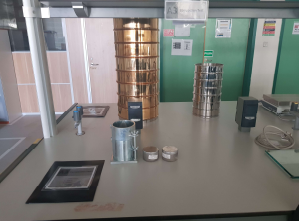
In the Highway Engineering Laboratory, students learn to conduct the following tests:
- Determination of kinematic viscosity, flash and fire points, and specific gravity of asphalt
- Determination of ductility of bituminous materials
- Los Angeles Abrasion test for aggregates
- Sieve analysis of aggregates
- Penetration test for bituminous materials
- Determination of skid resistance of aggregates
- Specific gravity and absorption tests for fine aggregates
- Softening point test for bitumen
- Marshall stability test

In the Fluid Mechanics and Hydraulics Laboratory, students learn to conduct the following experiments:
- Determination of fluid properties
- Measurement of flow in pipes (closed conduit flow) and open channels
- Study of viscosity effects and Bernoulli’s principle
- Pressure loss and minor losses in pipe systems

The Surveying Laboratory aims to train students in the following:
- Chain surveying practice
- Use of leveling instruments and execution of leveling works, including longitudinal and cross-sectional leveling and setting out elevations
- Use of the theodolite in traverse surveying
- Measurement of horizontal distances and elevation differences using the tacheometer
- Area measurement using the planimeter
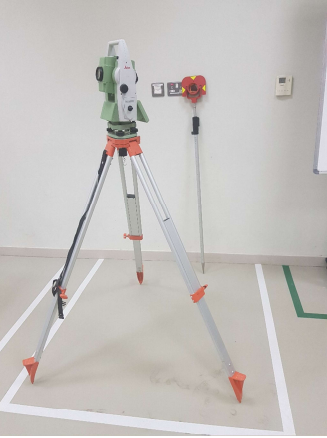
- Use of electronic surveying instruments (Total Station)
- Use of laser theodolite and laser level
- Computer applications in surveying
The Rock Mechanics Laboratory is equipped with the necessary instruments for testing different types of rocks. It is used to determine basic rock properties, shear strength parameters of rocks, aggregate properties, rock strength, swelling pressure, swelling potential, and rock compressibility parameters. The laboratory also contains equipment required for conducting both experimental research tests in the laboratory and field investigations.

The Computer Laboratory aims to equip students with skills in 2D and 3D drawing using computer software. It also aims to train students in the use of computer programs across various fields of civil engineering.